
AC Coil Cleaner Spray vs Duct Cleaning: What Actually Fixes That Smell
You start the car after it’s been parked in the sun. Turn the AC on. And for about fifteen seconds there’s that smell — damp, sour, slightly like an old gym bag.
Then it fades, and you forget about it until tomorrow morning.
Most people respond by hanging a perfume card from the vent or emptying half a can of air freshener into the cabin. It works for two days. The smell comes back, because the perfume was never touching the thing causing it.
Where the smell actually comes from
An air conditioning evaporator is cold, wet and dark. Air passes over it carrying dust, pollen, road grime, skin cells, cooking smoke, tobacco residue and everything else in the environment. Condensate forms on the fins. The dust sticks to the moisture.
That is, essentially, a nutrient-rich damp surface with no light and no airflow when the car is off. Bacteria and mould colonise it and form a biofilm across the fin pack.
When you switch the AC on, the first rush of air blows the by-products of that biofilm straight into the cabin. That’s the smell. And in India, where the monsoon adds months of high humidity to a year of heavy road dust, the colonisation happens faster than it does almost anywhere else.
So the smell isn’t in the ducts. It’s on the coil.
Why deodoriser alone doesn’t fix it
A deodoriser addresses odour. A cleaner addresses the source of the odour. They’re different jobs, and the sequence matters.
Spray a fragrance into a system with an active biofilm on the evaporator and you get perfumed mould smell. Two days later you get plain mould smell again, because nothing was removed.
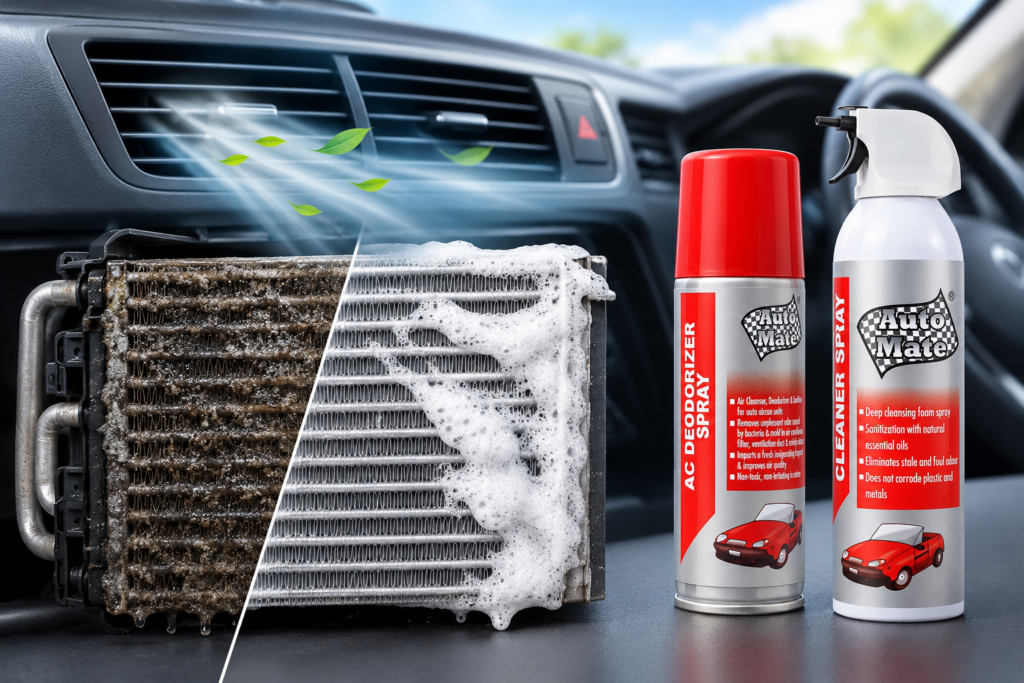
The correct order is: clean the coil first, then deodorise the system and the interior surfaces. Auto Mate® AC Deodorizer is built for that second step — it works on the pollen and dust filter where bacteria and mould breed, and its spray system evacuates the can within a minute so the contents saturate the aircon system and interior surfaces rather than misting the dashboard.
But it follows the cleaner. It doesn’t replace it.
Why foam, and not liquid
Here’s the practical problem with cleaning an evaporator: you can barely reach it.
The evaporator core sits deep inside the HVAC housing, behind the blower, behind the filter, in a space designed for airflow and not for a human hand. You’re working through an access point the size of a matchbox, sometimes through the drain tube.
A liquid cleaner sprayed into that space runs straight down the fins and out of the drain in about four seconds. Contact time with the contamination: almost none.
Air conditioner cleaner foam solves this. The foam expands to fill the fin pack, clings to the vertical surfaces, and stays in contact long enough for the surfactants to lift the soil. Then it collapses into a liquid and carries the contamination out through the condensate drain.
Auto Mate® AC Evaporator Foam Cleaner works on that principle. It’s a foaming cleaner with sanitizing properties, built on a natural, biodegradable surfactant base that cleans the fin surface, eliminates odour-causing organisms and deodorises the unit as it goes. It also handles the food and tobacco smells that soak into a car interior over years.
How to clean a car AC evaporator properly
1. Replace the cabin filter first. There’s no point cleaning the coil and then pulling air through a filter caked with a season’s worth of dust. New filter, then clean.
2. Find the access route. Usually through the cabin filter housing, or the blower motor opening, or the evaporator drain tube. Check the service manual — HVAC box layouts differ significantly between models.
3. Locate the condensate drain and make sure it’s clear. All the foam and everything it lifts has to come out somewhere. A blocked drain means dirty water pooling in the HVAC box, which creates a worse problem than the one you started with.
4. Apply the foam across the fin pack. Use the extension tube. Work it across the width of the core rather than dumping the whole can in one spot. Coverage matters more than quantity.
5. Let it dwell. Follow the product’s stated time. The foam needs to expand, work, and break down. Cutting this short is the main reason a cleaning job disappoints.
6. Run the blower on high with the AC off and the windows open. This dries the core and pushes the residue out through the drain. Check that water is actually coming out under the car.
7. Deodorise, then replace the filter. With the coil clean, the deodoriser now has a fresh surface to work on and the result holds.
When you actually need duct cleaning
AC duct cleaning is a separate service and it’s genuinely necessary in some situations — just not usually the ones people call it for.
Ducts need cleaning when there’s visible debris or dust discharge from the vents, after construction or renovation work has pushed fine dust into the system, following water ingress or a flood, or when there’s evidence of rodent or insect activity inside the ductwork. In large commercial and industrial buildings, duct hygiene is a recurring maintenance item covered by facility standards.
In a car, there are barely any ducts to speak of — just short runs from the HVAC box to the vents. If you have a smell, the coil is the culprit in almost every case.
In a residential split AC, the same logic applies. There’s no duct system. The evaporator coil, the blower wheel and the filter are where the contamination lives.
For a ducted or central system in a home or office, ducts do matter — but even then, cleaning ducts while leaving a fouled coil in place means the smell returns. Coil first, always.
How often should you do this?
Cabin filter: every 10,000–15,000 km, or twice a year in dusty conditions. In Delhi NCR, twice a year is the realistic minimum.
Evaporator coil cleaning: once a year for most vehicles. Before summer is the sensible slot — you’re cleaning out what accumulated over the monsoon.
Deodorising: as needed, and after every coil clean.
Duct cleaning (buildings): every three to five years under normal conditions, sooner after renovation or water damage.
For workshops and fleets
Aerol manufactures the Auto Mate® range of automotive cleaners and MRO aerosols for workshops, detailing centres and service stations, produced at an ISO 9001:2015 and ISO 45001:2018 certified facility in Haryana. The company supplies own-brand product as well as ODM, white label and private label manufacturing for distributors and service chains.
For workshop pricing, technical data or dealer enquiries, contact the Aerol team.
FAQs
Why does my car AC smell bad when I turn it on?
Because a biofilm of bacteria and mould has formed on the damp evaporator coil. The coil is cold, dark and wet, and dust drawn in through the vents sticks to the condensate and feeds microbial growth. The first burst of air after startup carries those by-products into the cabin.
Does AC duct cleaning fix the smell?
Usually not, because in cars and split ACs the smell comes from the evaporator coil rather than any ductwork. Duct cleaning is worthwhile in ducted buildings after construction dust, water ingress or pest activity — but if the coil is fouled, the smell returns regardless.
What’s the difference between AC coil cleaner and AC deodoriser?
A coil cleaner removes the contamination and the organisms causing the odour. A deodoriser neutralises smell and freshens the system. Use the cleaner first; a deodoriser applied over an unclean coil only masks the problem for a few days.
Why use foam instead of a liquid AC cleaner?
Foam expands to fill the fin pack and clings to vertical surfaces, so it stays in contact with the contamination long enough to lift it. A liquid runs straight down the fins and out through the drain within seconds.
How often should a car AC evaporator be cleaned?
Once a year suits most vehicles, ideally before summer. In heavy dust or high humidity, or if the car is regularly parked outdoors, more frequently. Replace the cabin air filter at the same time.
Can I clean the evaporator myself?
Yes, on most vehicles, provided you can reach the core through the cabin filter housing, blower opening or drain tube and you can confirm the condensate drain is clear. Check the service manual for your model first — HVAC box layouts vary a lot, and some cars need the blower removed.
Is AC evaporator foam cleaner safe for the system?
A properly formulated automotive evaporator cleaner is designed to be compatible with aluminium fins, the housing and the seals. Use a product intended for the job — household or degreasing chemicals can attack fin coatings and plastics.