
Instant Cooling Spray: How Freeze Spray Finds Faults in Seconds
There’s a particular kind of fault every electronics technician has learned to dread. The board works fine on the bench. It works fine for an hour. Then, twenty minutes into a production run, it drops out — and by the time you’ve got a probe on it, it’s working again.
Intermittent thermal faults are miserable to diagnose because the failure only exists when the component is hot, and the component is only hot when you’re not looking at it.
An instant cooling spray is how you catch it.
What an instant cooling spray does
An instant cooling spray, also called a freeze spray or rapid freeze spray, is an aerosol that lowers the temperature of any surface it’s applied to, immediately and locally. The liquefied gas inside the can absorbs heat as it evaporates on contact, pulling the surface temperature down within a second or two.
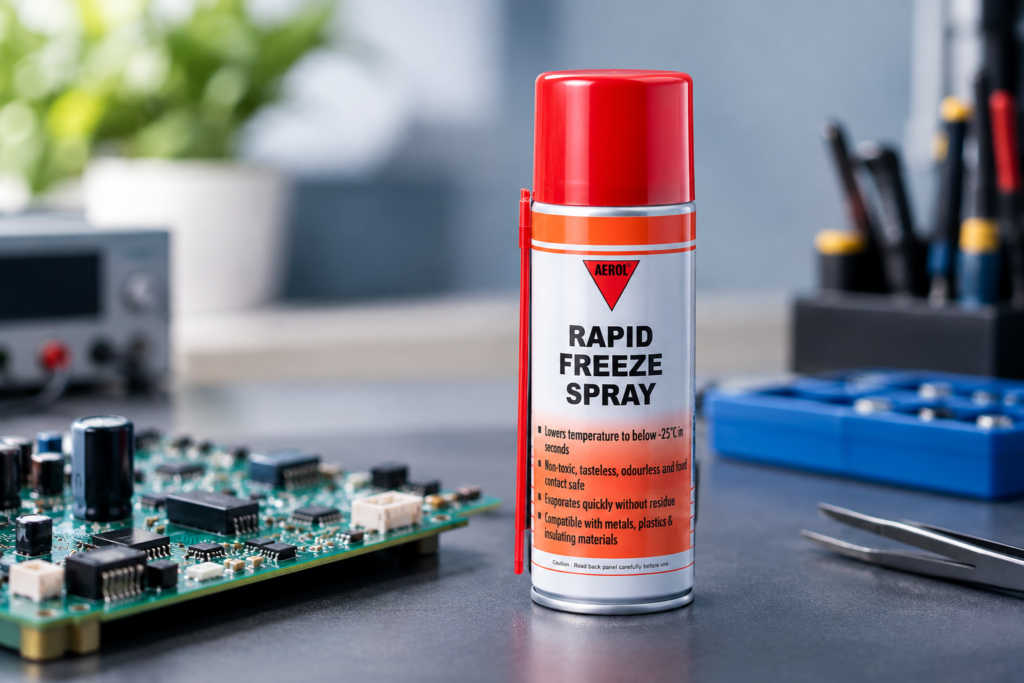
Aerol® Rapid Freeze Spray is a multipurpose product of this type. It cools machine parts, electrical circuits and electronic components, and it carries a mint scent rather than the harsh solvent smell of some older formulations.
The mechanism is the same one that makes your skin feel cold when spirit evaporates off it — just far faster and far colder.
Finding a thermal intermittent, step by step
This is the classic use, and it works because most heat-sensitive failures reverse when the component cools.
1. Run the board until it fails. You need the fault present. Let it reach the operating temperature where the symptom appears.
2. Cool one component at a time. Fit the extension tube. Short bursts, one component, then check whether the symptom clears.
3. Watch for the moment it comes back to life. If the circuit recovers the instant you cool a specific capacitor, solder joint or IC, you’ve found it. A component that only misbehaves above a certain temperature is telling you it has a marginal junction, a dried-out electrolytic, or a hairline crack in a joint that opens as the metal expands.
4. Confirm by letting it warm again. The fault should return. If it does, you’ve isolated it — not guessed at it.
Blanket-cooling the whole board tells you nothing except that the board is cold. The value is entirely in doing it component by component.
Where else freeze spray gets used
Locating cracked solder joints. Thermal cycling opens and closes microscopic cracks. Cooling a suspect joint while the circuit runs makes the connection state change, which is far more definitive than staring at it under a loupe.
Cooling machine parts during maintenance. A localised chill contracts metal slightly, which helps with interference fits and with easing components apart without heat, flame or force.
Testing thermal cut-outs and sensors. Thermostats, thermal switches and temperature sensors need to be verified at the cold end of their range, not only the hot end.
On-the-spot dental testing. Freeze sprays are used for pulp vitality testing, where a controlled cold stimulus is applied to a tooth to check nerve response.
As a replacement for an ice pack. Rapid cooling gives immediate relief on a sports or workplace injury when no ice is available. It’s a stopgap for first response, not a treatment.
Sample preparation. Some materials cut, snap or section far more cleanly when chilled hard first, particularly soft polymers and adhesives that smear at room temperature.
Using it without causing damage
Freeze spray is genuinely useful and genuinely capable of wrecking things when used carelessly. A few rules.
Short bursts, not continuous streams. Two seconds does the job. Ten seconds gets you condensation, thermal shock and possibly a cracked component.
Mind the condensation. Cool a surface below the dew point and moisture will form on it the moment you stop spraying — and in Indian humidity, that happens fast. On a powered board, that water is a short circuit waiting to happen. Cool, observe, let it recover, wipe if needed.
Thermal shock cracks things. Ceramics, glass, some plastics and certain SMD packages don’t enjoy going from 70°C to sub-zero in one second. On fragile components, use shorter bursts from further away.
Protect your hands and eyes. The spray and the surfaces it lands on get cold enough to cause cold burns. Gloves and eye protection, every time.
Ventilate. Aerosol propellants displace air in confined spaces. Don’t use it inside a closed cabinet with your face in there.
Read the safety data sheet before use near live circuits or ignition sources. Formulations differ in flammability. Never assume — check the SDS for the specific product and grade you have, and de-energise where you can.
Don’t spray it as a personal coolant. People do this in hot weather. It’s not what the product is for, the cooling is aggressive enough to cause skin injury, and inhalation risk is real.
Freeze spray versus a thermal camera
Both are diagnostic tools and they answer different questions.
A thermal camera shows you what’s hot. That’s useful for spotting a component drawing too much current, but plenty of failing parts run at perfectly normal temperatures and still misbehave when warm.
Freeze spray shows you what’s temperature sensitive. That’s a different and often more useful signal. A component that runs at 55°C like all its neighbours, but only fails above 50°C, is invisible to a camera and obvious to a can of freeze spray.
Most experienced technicians use the camera to narrow the search area and the freeze spray to confirm the culprit.
Sourcing and supply
Aerol manufactures Rapid Freeze Spray as part of its industrial MRO aerosol range, produced at an ISO 9001:2015 and ISO 45001:2018 certified facility with in-house testing. The company also supplies on an ODM, white label and private label basis for distributors and OEMs who need the product under their own brand.
For bulk requirements, technical data or dealer enquiries, get in touch with the Aerol team.
FAQs
What is instant cooling spray used for?
It’s used to lower the temperature of a surface on contact — most commonly to trace thermal intermittent faults in electronic circuits and PCBs, to cool machine parts during maintenance, to test thermal switches and sensors, and for on-the-spot cold testing in dentistry. It also serves as an emergency substitute for an ice pack.
How does freeze spray find a faulty component?
Many electronic failures only appear once a component gets hot. Cooling components one at a time while the fault is present lets you see which one restores normal operation the moment it drops in temperature. That isolates the fault to a single part rather than a whole board.
How cold does a rapid freeze spray get?
It drops the surface temperature well below freezing within a second or two of contact. The exact figure depends on the formulation, spray duration and the thermal mass of the surface — check the product’s technical data sheet for the specific grade.
Is freeze spray safe on electronic components?
Used in short bursts, yes — it’s designed for the job. The two risks to manage are condensation forming on a powered board as the surface warms back up, and thermal shock cracking fragile ceramic or glass packages. Short bursts from a sensible distance handle both.
Can I use cooling spray on my skin?
Only in the specific first-aid context of replacing an ice pack, applied briefly and never directly held on one spot. It is not a personal cooling product. Prolonged contact causes cold burns, and inhaling the vapour is hazardous.
Is instant cooling spray flammable?
It depends on the propellant and formulation. Always read the safety data sheet for your specific product before using it near live circuits, sparks or open flame, and de-energise equipment wherever the work allows.
What’s the difference between freeze spray and compressed air duster?
Different products for different jobs. A duster blows contamination off a surface. A freeze spray is formulated to remove heat from it. Inverting a duster can produce cooling, but it’s uncontrolled and can leave residue on the board.