
Graphite Dry Lube Spray: When a Dry Lubricant Beats Oil and Grease
Walk into a cement plant, a textile mill or a foundry and look closely at an oiled conveyor chain. You won’t see oil. You’ll see a black-grey paste of grit and old lubricant, thick as putty, packed into every link.
That paste is not lubricating anything. It’s grinding.
This is the single reason dry lubricants exist. In dusty plants, wet lubricants stop being lubricants within days of application. They turn into an abrasive slurry that wears out the component faster than running it dry would have.
A dry graphite spray solves it in a way no oil can: it lays down a solid film, dries, and gives dust nothing to stick to.
What a dry lubricant actually is
A dry lubricant is a solid material — graphite, molybdenum disulfide, PTFE, boron nitride — that reduces friction between two surfaces without a liquid carrier staying behind. The spray carries the solid to the surface, the carrier evaporates, and the solid stays bonded as a thin film.
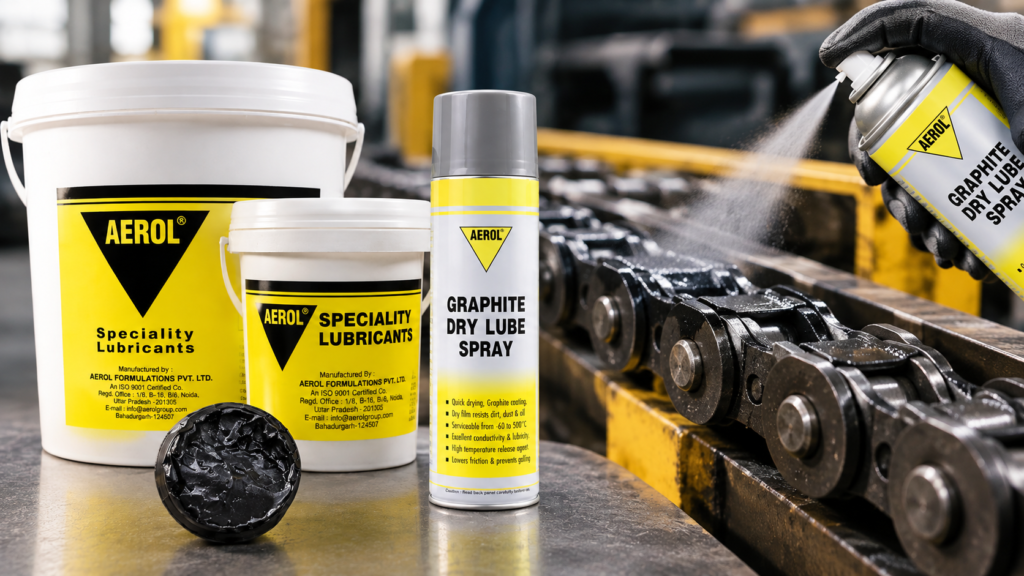
Aerol® Graphite Dry Lube Spray is a bonded dry film lubricant of this type. It air-dries into a smooth, black, paint-like coating that grips metal, rubber and plastic, and it holds up to 450°C. No heat curing, no oven, no post-treatment. Spray it, let it dry, run the machine.
Why graphite works at all
Graphite is built in flat hexagonal sheets of carbon. The bonds inside each sheet are strong. The bonds holding one sheet to the next are weak.
So when two surfaces press together with graphite between them, those sheets slide over one another like a deck of cards being fanned. The load transfers. The friction doesn’t.
That layered structure is also why graphite survives heat that would carbonise an oil. There’s nothing to break down — it’s already carbon.
The five situations where graphite dry lube earns its place
1. Anywhere dust is unavoidable. Cement, textiles, mining, quarrying, sugar, ceramics. If you can write your name on a gearbox, wet lubricant is the wrong answer for exposed components.
2. High-temperature contact points. Oven chains, furnace door hinges, kiln castors, hot billet handling. Ordinary grease runs out or bakes into varnish. A graphite film keeps working past the point where mineral oil is already gone.
3. On rubber and plastic. Mineral oils swell and soften elastomers. Over months, a rubber bush lubricated with the wrong product goes spongy and fails. Graphite dry film doesn’t attack these substrates, which makes it useful on plastic slides, rubber-to-metal contacts and moulded assemblies.
4. Where you can’t have oil migration. Textile machinery near yarn. Packaging lines near print. Gaskets and transfer belts where a drop of oil means a rejected batch.
5. As a release agent. Graphite is a genuine parting agent for diamond segment moulding in cutting tool manufacture, and for several casting and die operations where the part must let go cleanly at temperature.
Graphite lubricant uses on the shop floor
The practical list is longer than most maintenance teams realise:
- Gaskets, transfer belts and conveyor belts
- Assembly lube on motors, plant machinery and handling equipment
- Machine components, slides, rollers, wheels
- Gears, chains and hoists carrying load at speed
- Locks, latches, hinges and window tracks that must not gum up
- Leaf springs and exposed automotive linkages
- Threaded parts before a high-temperature service life
For threads that also have to come apart again after heat cycling, an anti-seize compound is usually the better tool. For heavy sliding contact where you want a grease body carrying the solid, look at graphite grease instead.
Graphite vs the other dry lubricants
| Graphite | Moly (MoS₂) | PTFE | |
| Works best under | Heat, sliding contact | Very high load, low speed | Low load, clean/food-adjacent |
| Temperature ceiling | Highest of the three | High | Lowest of the three |
| Needs moisture present | Yes — dry vacuum reduces performance | No, works in vacuum | No |
| Electrically | Conductive | Conductive | Insulating |
| Colour left behind | Black | Dark grey | White/clear |
That moisture point catches people out. Graphite relies on adsorbed water vapour between its layers to shear easily. In normal Indian plant air, that’s never a problem. In a vacuum chamber or a very dry inert atmosphere, moly is the safer choice.
How to apply it so it actually bonds
Most dry film failures are application failures, not product failures.
Clean first, properly. Dry film bonds to the substrate, not to the old grease on top of it. Degrease and let the surface dry completely. Skipping this is the number one reason a coating flakes off in a week.
Shake until you hear it. The solids settle. Shake for a good 30 seconds after the ball starts rattling.
Spray thin, from about 20–25 cm. Two light passes beat one heavy one. A thick coat dries with internal stress and chips at the edges.
Let it dry before load. Touch-dry is not the same as bonded. Give it time before the component takes its first cycle.
Reapply on a schedule, not on a squeak. Dry films wear away gradually rather than failing suddenly. Build reapplication into your PM interval.
Where a dry lubricant is the wrong choice
Being straight about this saves everyone a warranty conversation.
Graphite dry film is not a replacement for grease in high-speed rolling element bearings under continuous load — those need a fluid film and a grease that can carry heat away. It’s conductive, so keep it off live electrical contacts and switchgear (a contact grease is formulated for that job). It won’t help a component that’s already worn out of tolerance. And on stainless steel in some critical applications, carbon contact is restricted by spec — check your drawing before you spray.
If the part is running hot, dusty and sliding, graphite is very likely the right answer. If it’s running fast, sealed and clean, it isn’t.
Getting the grade right
Aerol manufactures dry film lubricants alongside a full grease and speciality lubricant range from an ISO 9001:2015 and ISO 45001:2018 certified facility in Bahadurgarh, Haryana. If you’re switching a line off wet lubrication and want the temperature, load and substrate checked before you commit, send the application details through the technical specifications request.
FAQs
What is graphite dry lube spray used for?
It’s used to lubricate components where oil and grease would attract dust or burn off — conveyor and transfer belts, gaskets, oven and furnace chains, slides, rollers, gears, hoists, locks, hinges and leaf springs. It also works as a release agent in casting and diamond segment moulding.
What temperature can a dry graphite spray handle?
Aerol’s Graphite Dry Lube Spray coating withstands temperatures up to 450°C, well beyond the point where mineral oil-based lubricants oxidise and fail.
Is graphite better than grease?
Neither is better overall — they solve different problems. Grease is better for sealed, high-speed, high-load bearings where a fluid film is needed. Graphite dry lube is better in dust, in heat, and on rubber or plastic parts that oil would degrade.
Does graphite spray damage rubber or plastic?
No. Unlike mineral oil-based lubricants, which swell and soften elastomers over time, a bonded graphite dry film is compatible with rubber, plastic and metal substrates.
How long does a dry graphite coating last?
It depends on load, speed and contamination. Dry films wear down progressively rather than failing at once, so the practical approach is to reapply at a fixed maintenance interval rather than waiting for noise or binding.
Can I use graphite lubricant on electrical parts?
Not on live contacts. Graphite is electrically conductive and can create shorts or tracking. For switches, connectors and terminals, use a dielectric contact grease formulated for the purpose.
Do I need to heat cure it?
No. The Aerol coating is air-drying. It bonds to the substrate at ambient temperature without an oven or curing step.